Behavioral + spatial design · Resource loop

Bee_Hydrated

Reimagining campus drinking water as an experience people actually want — so the sustainable choice becomes the obvious one.

My role
Research lead &
behavioral design architect
Client
SCAD
graduate partnership
Recognition
Submitted, ILFI
Living Future Award
Approach
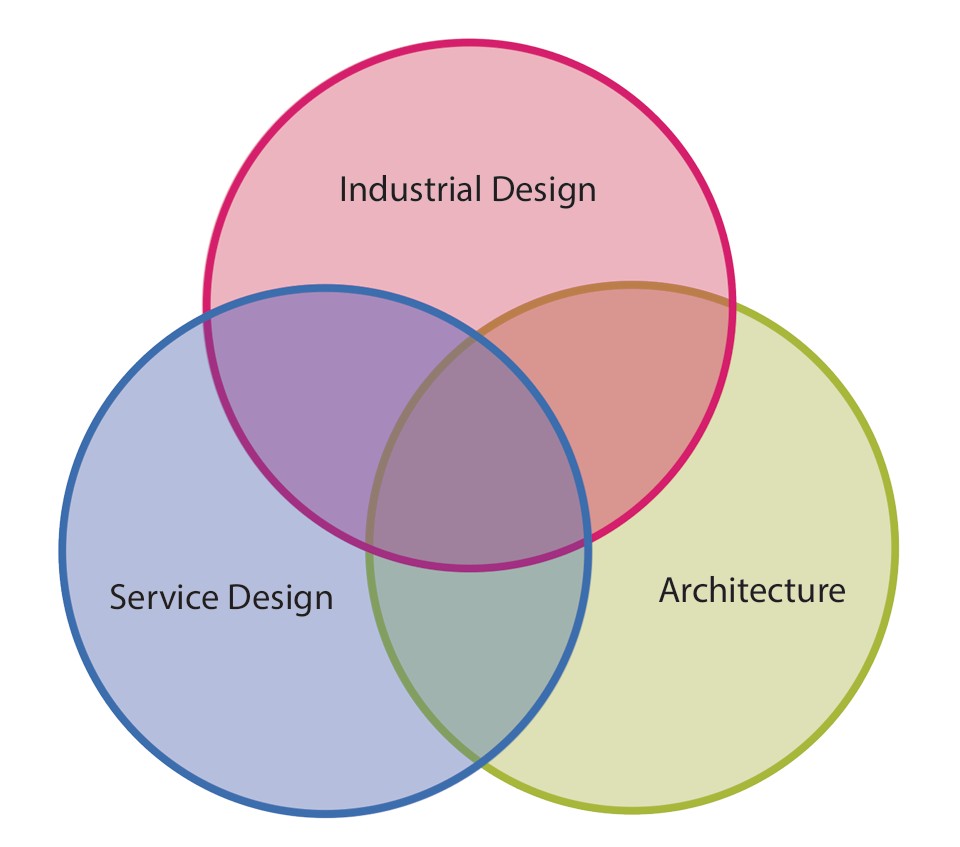
Product × Service
× Architecture
Bee_Hydrated — project snapshotproject snapshotimages/bee-snapshot.jpg
01 — The brief

Reimagine where campus water comes from

Bee_Hydrated is an immersive campus water experience built around four goals: eliminate plastic, educate, reduce reliance on city water, and reduce stress on campus. It was designed to International Living Future Institute principles and submitted for the Living Future Award.

Discipline

Product design

The dispenser and filtration hardware students actually touch.

Discipline

Service design

The journey, incentives, and habit loop around the water.

Discipline

Architecture

The space itself — built to the highest sustainability bar.
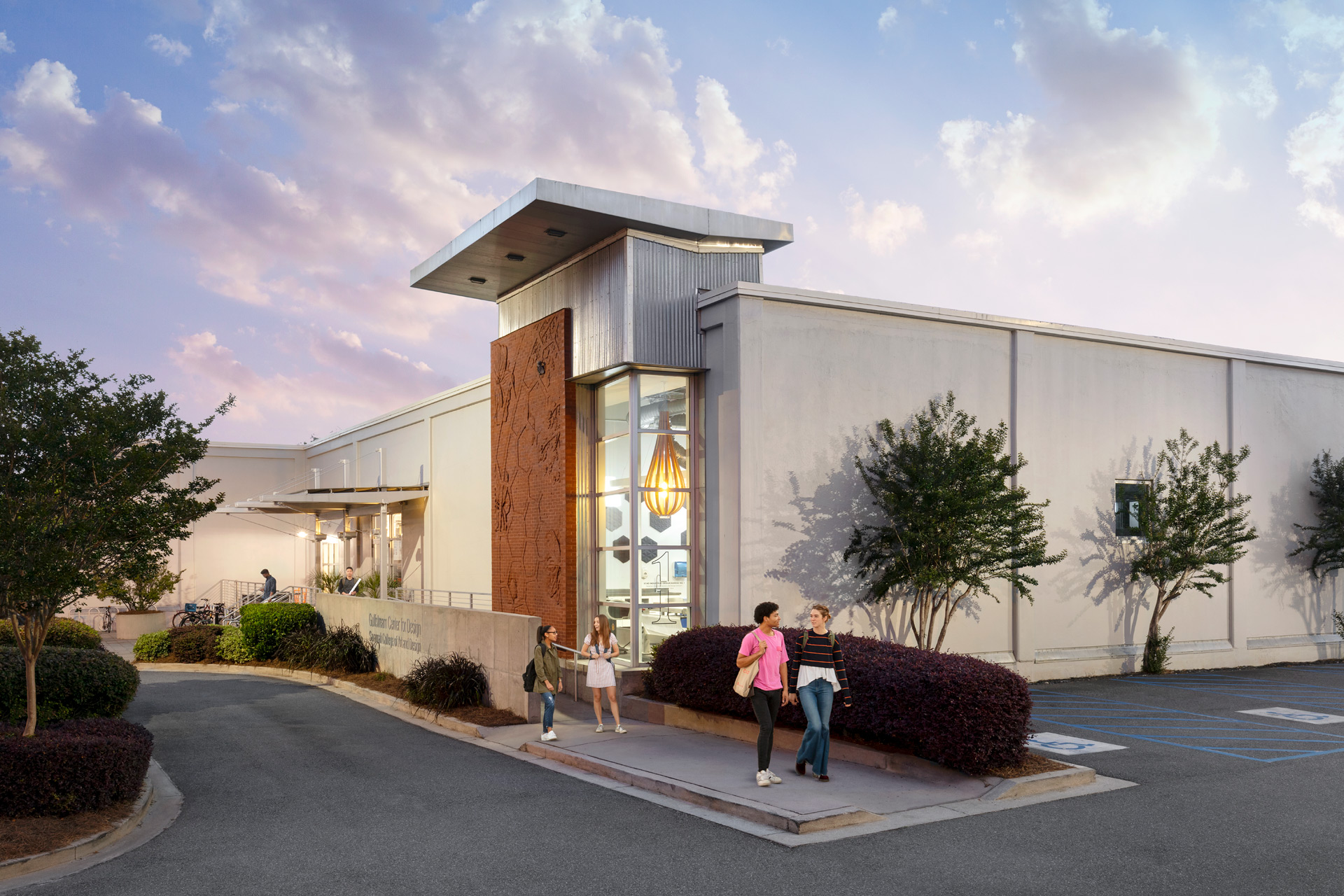
SCAD Gulfstream Center
SCAD Gulfstream
Center
images/bee-01.jpg
Three-discipline approach (Venn)
Three-discipline
approach (Venn)
images/bee-02.jpg
02 — Watch

Go see what people actually do

My roleAs research lead, I ran observational studies across three SCAD locations to find the gap between what's available and what people choose.
Kroger

Cheapest, always

Students pick the cheapest bottled water, regardless of promotions.

Cafe78

Forgotten bottles

When water costs the same as soda, they forget the bottle and switch drinks.

SCADfit

Unused stations

Fountains hidden and poorly maintained — the refill stations went unused the entire study.
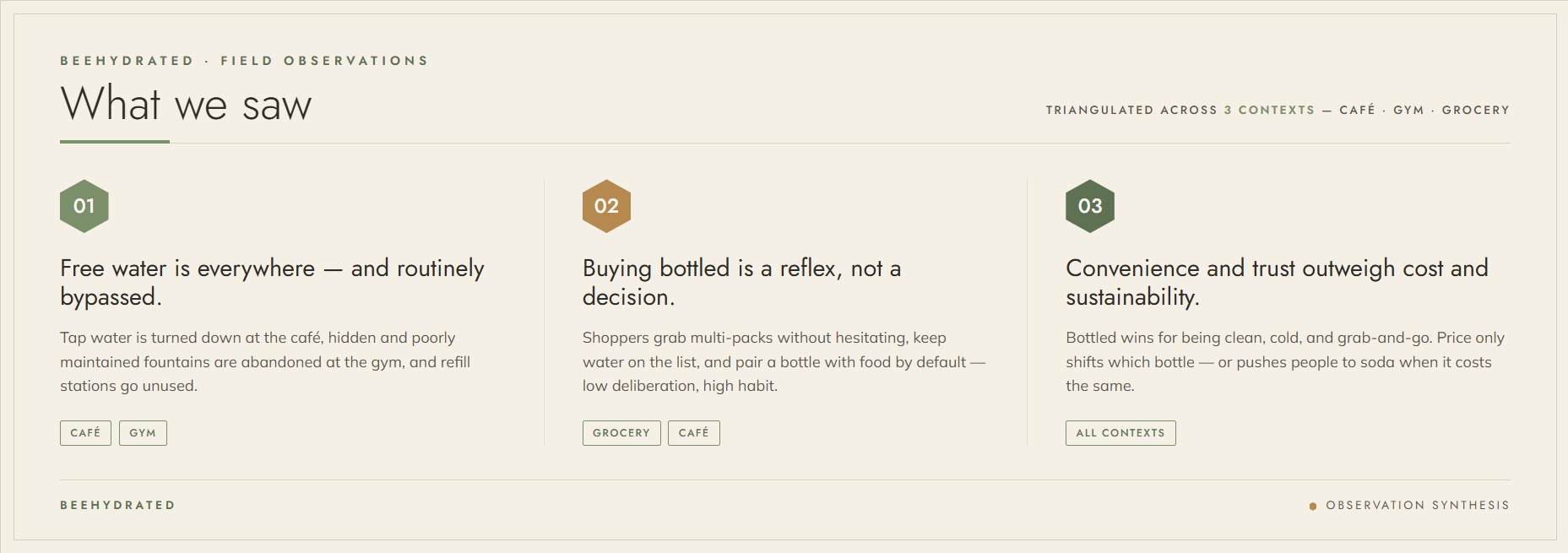
Observation — field study across three campus contexts
Observation — field study across three campus contextsimages/bee-03.jpg
03 — Taste-test

Test whether anyone can even tell the difference

My roleDesigned and ran a blind cultural probe — bottled vs. filtered vs. tap, judged on taste and smell alone.
14Blind taste-test participants
36%Correctly identified all three
57%Spotted tap by its chlorine taste
40%+Mistook filtered for bottled
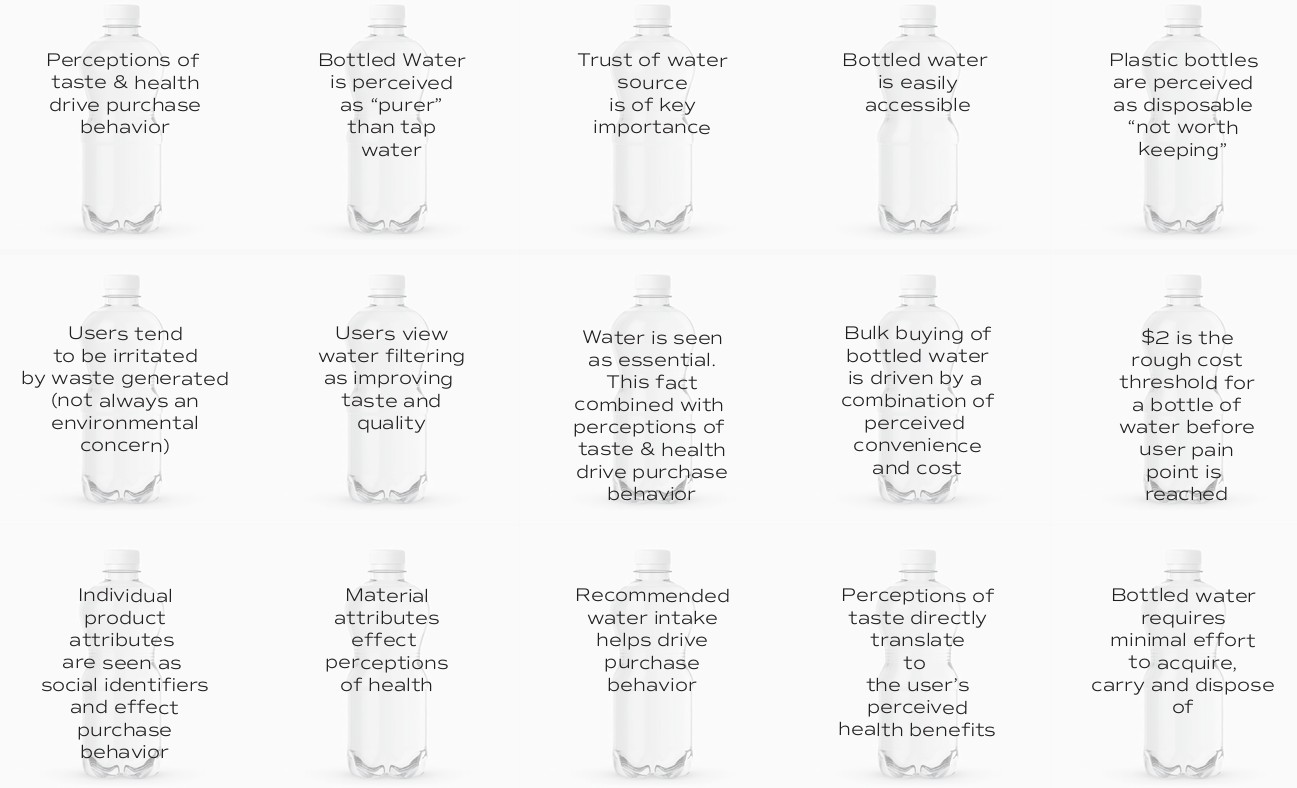
Students don't drink the cleaner water. They drink the water they trust.

Perception drives the choice, not chemistry — so any reusable solution had to make filtration something you can see.
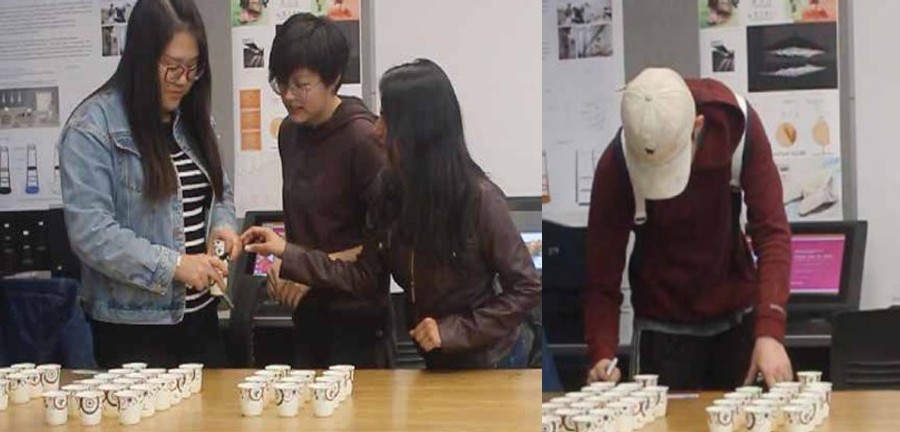
Blind taste-test in progress
Blind taste-test
in progress
images/bee-04.jpg
Perception insight grid
Perception insight
grid
images/bee-05.jpg
04 — Segment

Stop trying to convert everyone the same way

I synthesized the research into three personas and plotted each on B.J. Fogg's behavior model — B=MAT: Behavior = Motivation × Ability × Trigger — to design targeted interventions rather than force universal change.

High M · High A

Proactive

Already owns and uses a reusable bottle. Habit's there — just make it better.

Mixed · Volatile

Reactant

Curious and inconsistent. Open to trying, if the experience earns it.

Low M · Low A

Non-Reactant

Opts out over health and cleanliness perceptions — not spite.

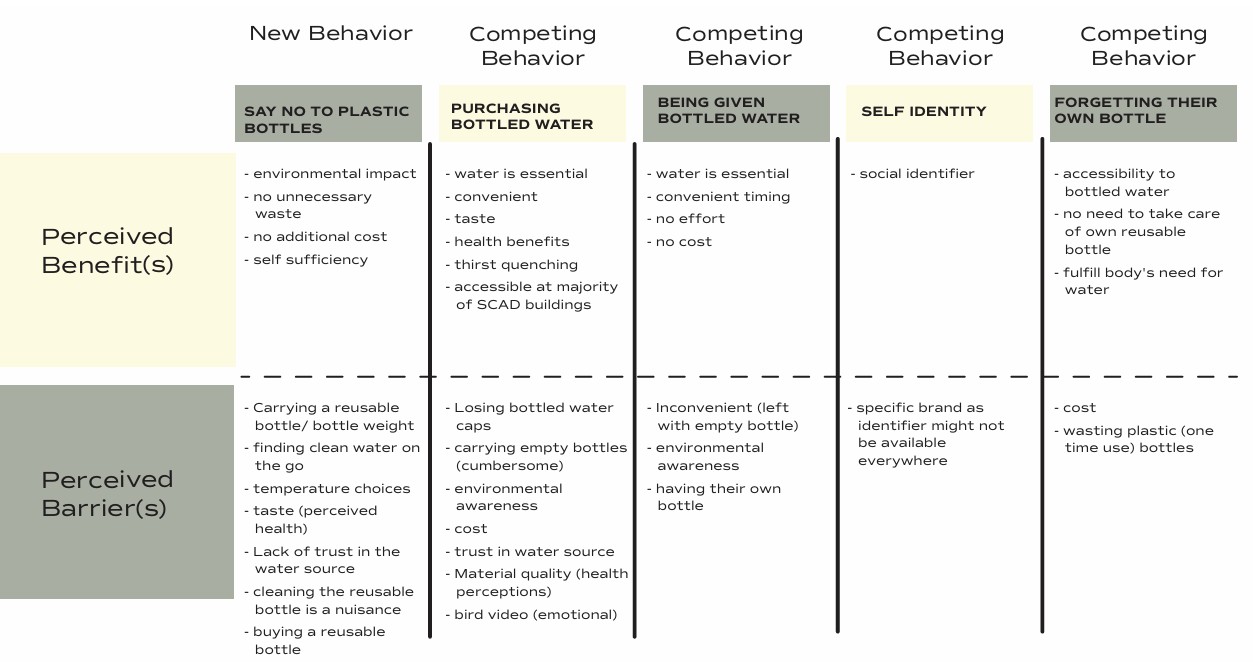
A behavior-comparison then mapped the new behavior against its competitors — buying, being given a bottle, identity, and simply forgetting your own — to see exactly what each persona had to gain and to overcome.
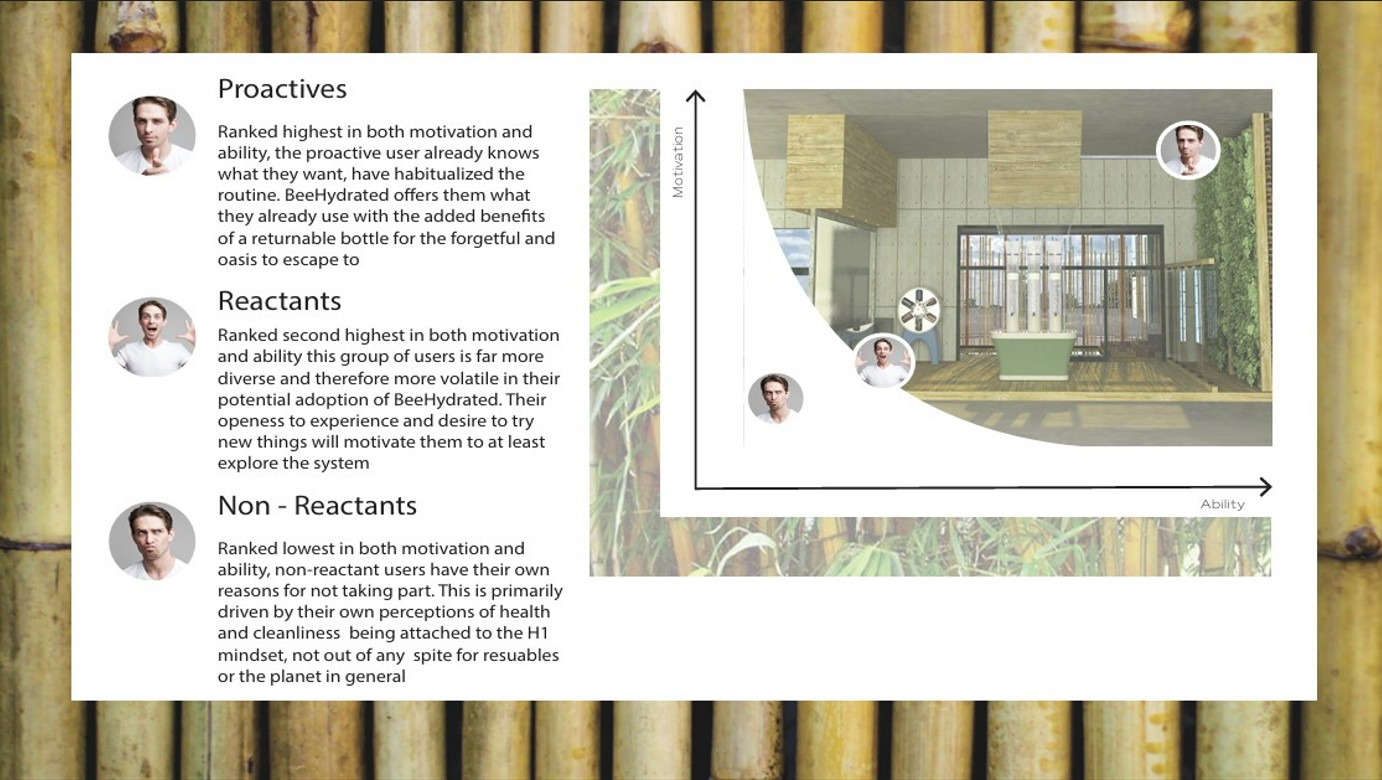
Persona map on motivation × ability
Persona map on
motivation × ability
images/bee-06.jpg
Behavior comparison (benefits vs. barriers)
Behavior comparison
(benefits vs. barriers)
images/bee-07.jpg
05 — Design the oasis

Make the sustainable choice the most appealing one

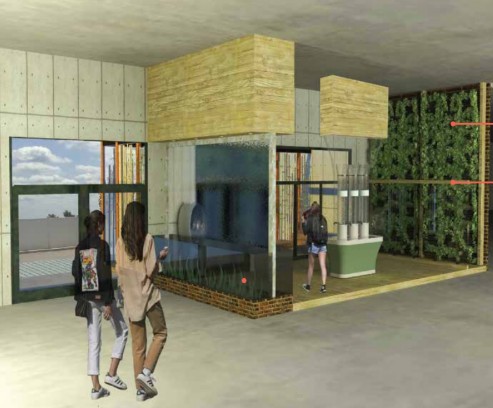
Bee_Hydrated lives in SCAD's Gulfstream Center — turning a utility into an oasis worth seeking out.

Answers the barrier

Visible filtration

A transparent six-nozzle station shows the water being cleaned — trust you can watch.

Removes friction

Gamified dispenser

Borrow a reusable bottle with a student ID; get your deposit back on return.

Draws people in

Sensory oasis

Living wall, bamboo screening, and water features make it a place to escape to.

Reinforces the habit

See the payoff

Educational panels and an automatic savings display make the benefit tangible.
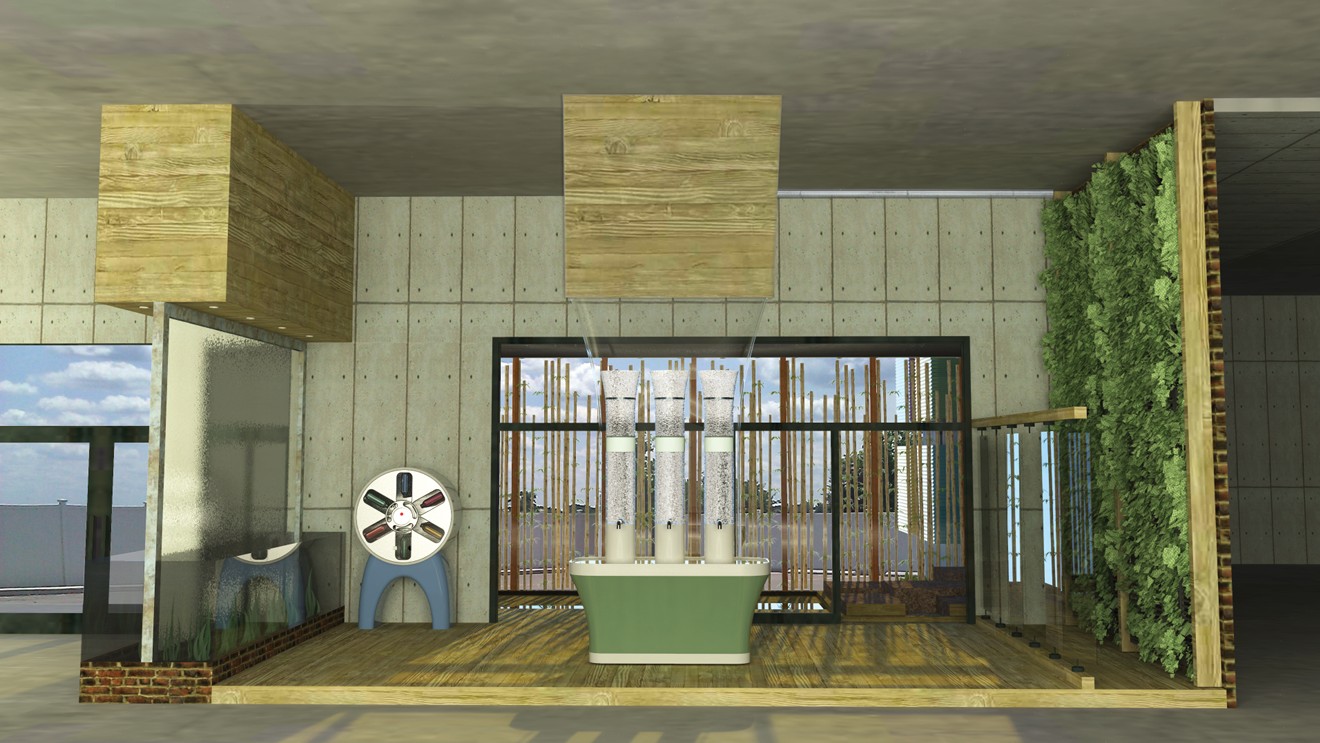
Space render — the oasis
Space render —
the oasis
images/bee-08.jpg
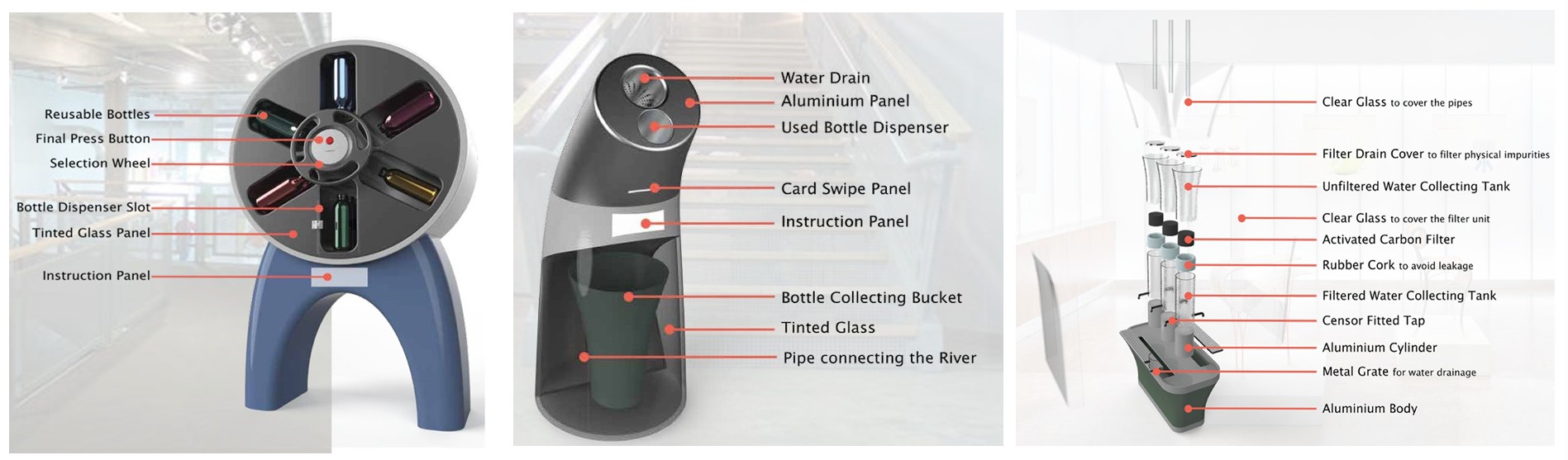
Industrial design — dispenser, filtration & disposal units (annotated)
Industrial design — dispenser, filtration & disposal units (annotated)images/bee-09.jpg
06 — Build to last

Hold it to the highest sustainability bar

The whole space is designed to Living Building Challenge criteria — across place, water, energy, health, materials, and equity.

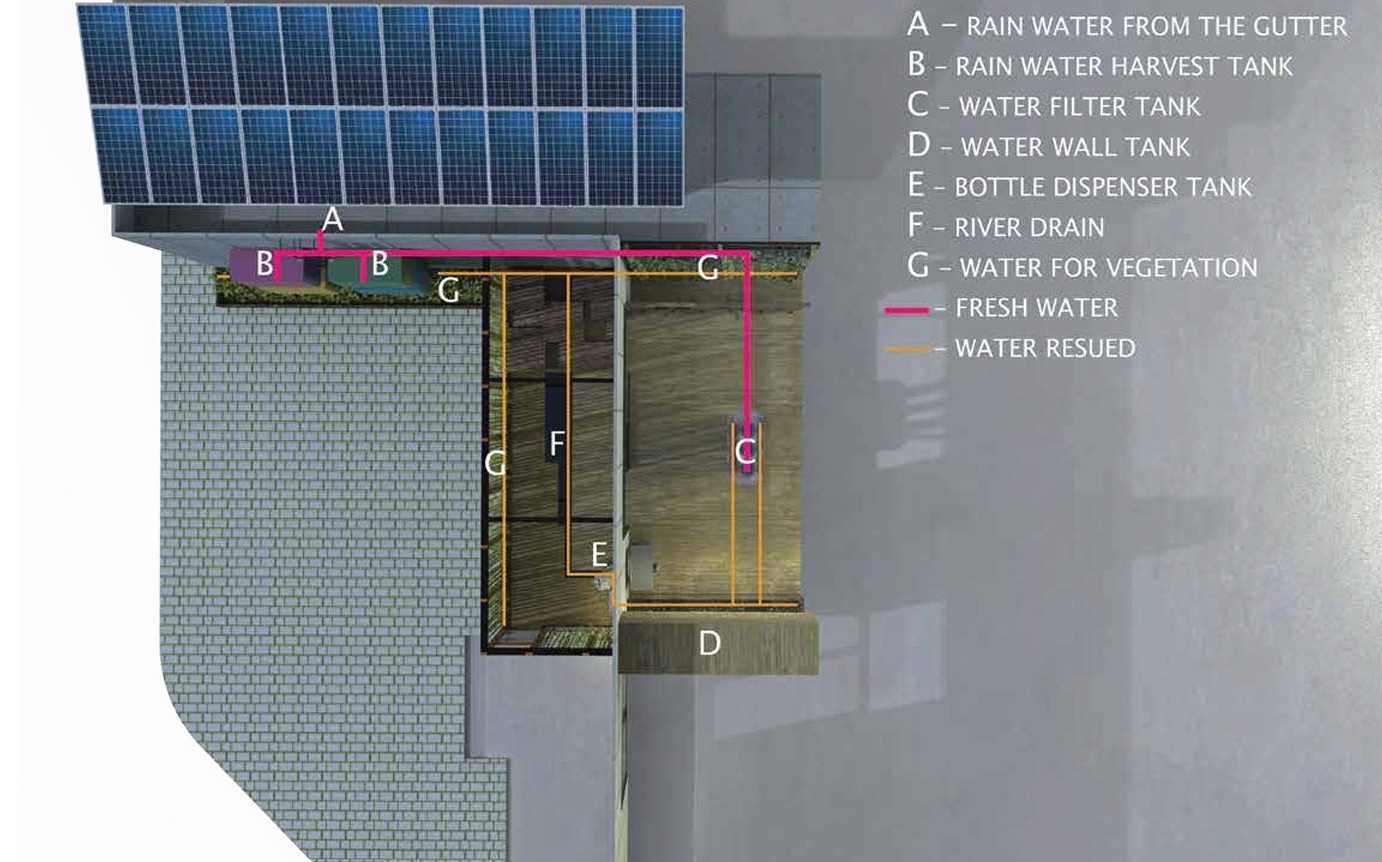
Net-zeroWater — closed-loop circulation
Net-zeroEnergy — solar powered

Rainwater is harvested from the roof, circulated through filtration and the living wall, and returned — with reclaimed, recyclable, local materials throughout.
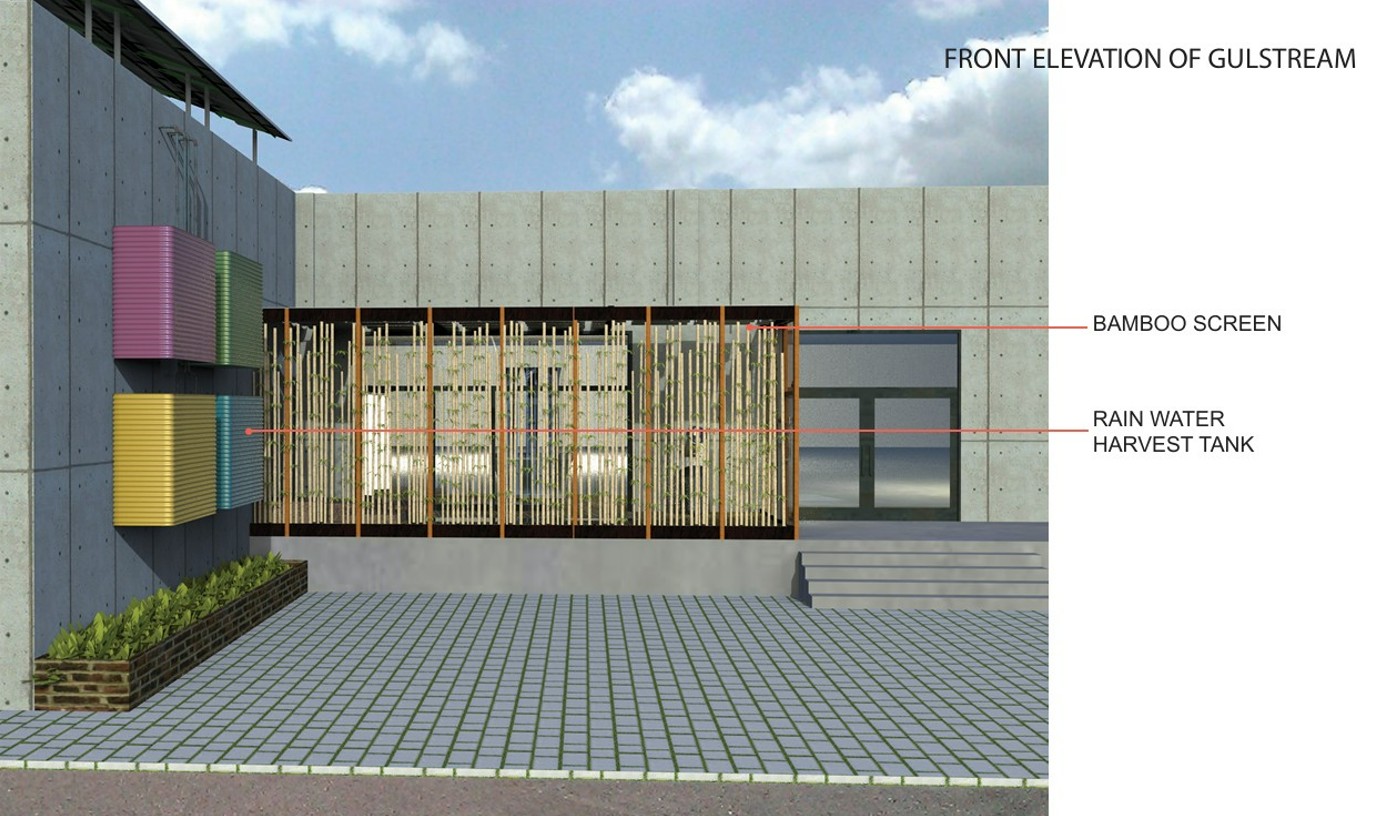
Front elevation — Gulfstream
Front elevation —
Gulfstream
images/bee-10.jpg
Water circulation diagram
Water circulation
diagram
images/bee-11.jpg
07 — Move each persona

Design a different path in for each mindset

Each persona meets a tailored trigger: Proactives get reinforcement and a backup bottle when they forget; Reactants are pulled in by novelty and visible water quality; Non-Reactants meet gentle pressure through the prominent location and education aimed at their health doubts.

The space works as a behavioral funnel — sensory cues, instant monetary feedback, and the physical sight of water flowing during a bottle return — split across two modes: Steer (sensory and educational nudges) and Force (the physical space plus student-ID access).
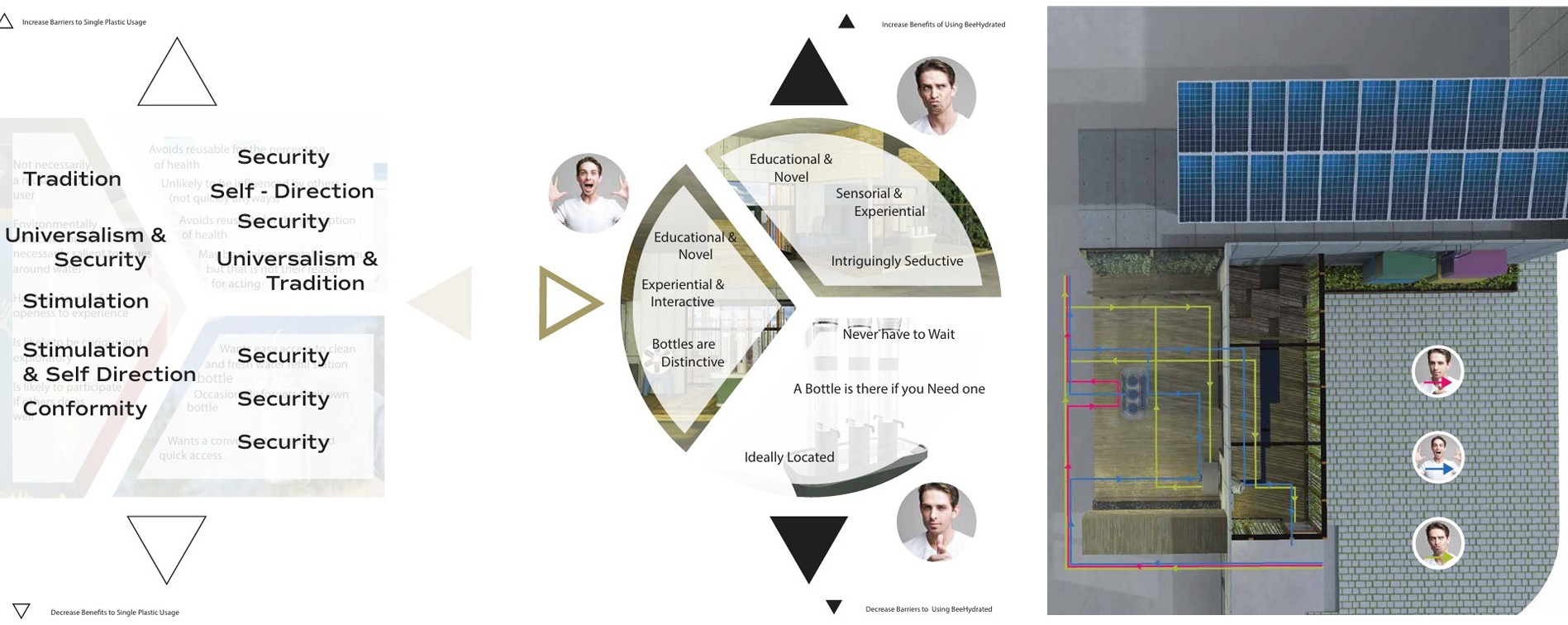
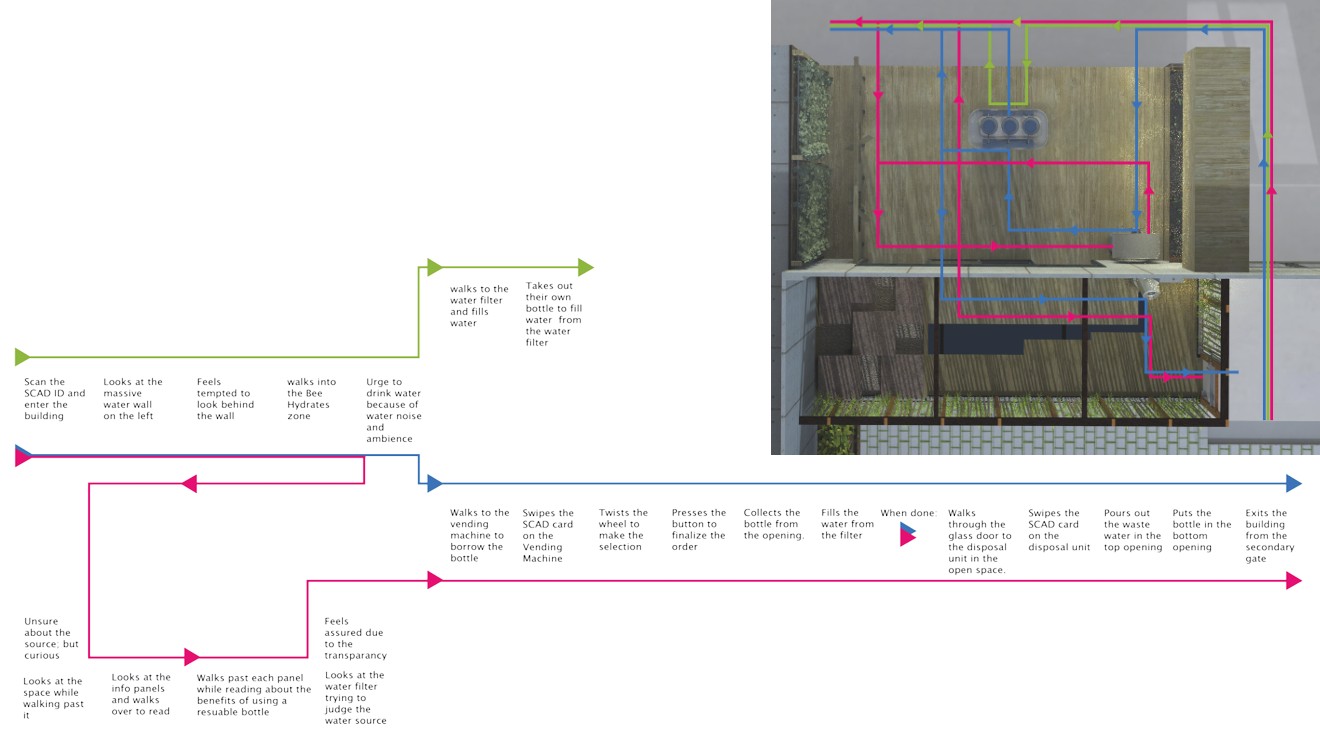
Journey map — the three persona paths through the space (proactive, reactant, non-reactant)
Journey map — the three persona paths through the space (proactive, reactant, non-reactant)images/bee-12.jpg
Persona walkthrough — additional view
Persona walkthrough — additional viewimages/bee-13.jpg

What Bee_Hydrated proves

The sustainable choice, made desirable.

Built for trust

Visible filtration answers the real barrier the research surfaced — perception, not chemistry.

Tailored, not forced

A different door in for Proactives, Reactants, and Non-Reactants alike.

Built to last

Designed to Living Building Challenge criteria — net-zero water and energy.

What it taught me

01

Research killed the obvious answer. Refill stations already existed and sat unused — the problem was never availability, it was trust and experience.

02

Segmented behavior change beats one-size-fits-all. Fogg's model let us design different doors in rather than one universal nudge.

03

Range as a system. Product, service, and architecture had to operate as one — a dispenser, a journey, and a building, designed together.